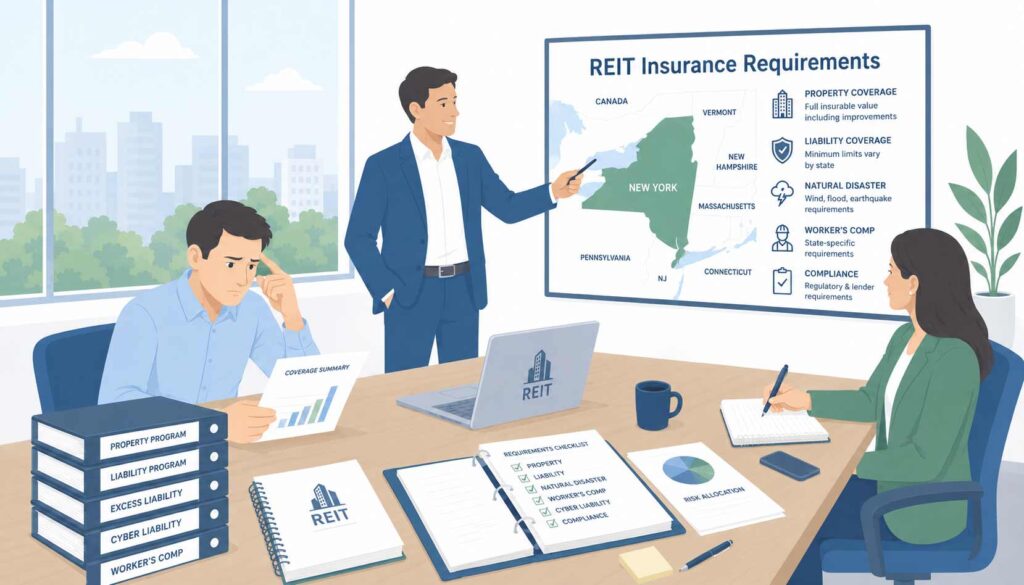





Real Estate Investment Trusts operate at a scale that most individual landlords and small property investors never touch. You’re not managing five rental houses or a couple of apartment buildings—you’re coordinating coverage across dozens, hundreds, or even thousands of properties spread across multiple markets, asset classes, and risk profiles.
That kind of portfolio complexity creates insurance challenges that go way beyond “call an agent and get a quote.” You’re dealing with aggregated catastrophe exposure, fluctuating property values, diverse tenant types, lender and investor requirements, regulatory compliance, and the need to control costs while maintaining institutional-grade coverage. One poorly structured policy or a gap in coverage can expose the entire portfolio to significant financial loss.
The insurance strategy that works for a single-property investor—grabbing individual policies, renewing on autopilot, maybe reviewing coverage once every few years—doesn’t scale to REIT-level operations. You need centralized risk management, coordinated policies, and a structure that can adapt as you acquire and dispose of properties without creating coverage gaps or administrative nightmares.
This article breaks down the insurance strategies that actually work for REIT property portfolios:
- Why multi-property portfolios face different risks than individual property owners
- How to structure policies efficiently across large portfolios (blanket vs. scheduled vs. master policies)
- Managing catastrophe exposure when properties are geographically concentrated
- Key coverage considerations for different asset types (multifamily, office, retail, industrial)
- How to handle insurance during acquisitions, dispositions, and portfolio transitions
Why REIT Portfolios Face Different Insurance Challenges
When you’re managing institutional-scale real estate, the risks multiply in ways that aren’t always obvious.
Aggregated Catastrophe Risk
If you own 50 apartment buildings across three counties and a hurricane, windstorm, or ice storm hits the region, you’re not dealing with one damaged property—you could be dealing with 10, 20, or more properties affected simultaneously. That’s millions of dollars in claims hitting at once, and it can overwhelm your coverage limits if they’re not structured correctly.
Geographic concentration amplifies this risk. A REIT focused on a single metro area or region has higher catastrophe exposure than one with properties spread across multiple states. Your insurance program needs to account for this through adequate limits, reinsurance structures, or catastrophe modeling.
Valuation Complexity
Property values fluctuate. You acquire properties, improve them, raise rents, and increase asset values over time. If your insurance values are static and based on outdated appraisals or purchase prices, you’re probably underinsured—and that becomes a massive problem when you have a total loss and the carrier only pays out based on the insured value, not the actual replacement cost.
REITs need a systematic process for updating property values annually (or more frequently) to make sure coverage keeps pace with actual exposure.
Lender and Investor Requirements
REITs typically have institutional lenders, investors, and boards that impose specific insurance requirements: minimum coverage limits, acceptable carriers (rated A- or better by A.M. Best), additional insured endorsements, loss payee clauses, and more. Your insurance program has to satisfy these requirements across the entire portfolio, and any gaps can trigger loan defaults or investor concerns.
Tenant and Lease Obligations
Different tenants have different insurance needs. A national retail chain leasing space in your shopping center will have specific insurance requirements in the lease. A small office tenant in a Class B building might have minimal requirements. A REIT managing mixed-use or multi-tenant properties needs to make sure tenant insurance obligations are tracked, enforced, and coordinated with the master property policy.
Operational Complexity
REITs often use third-party property management companies, maintenance contractors, and leasing agents across their portfolios. That introduces additional liability exposure—and the need for proper certificates of insurance, additional insured endorsements, and liability coordination with vendors and service providers.
Structuring Policies for Multi-Property Portfolios
One of the biggest decisions a REIT faces is how to structure insurance across the portfolio. There are three main approaches, and the right one depends on portfolio size, property types, and operational complexity.
Individual Policies (Property-by-Property)
This is the least efficient option for REITs but sometimes necessary for properties that don’t fit into a master program—properties in non-standard markets, high-risk locations, or buildings with unique exposures.
- Pros: Flexibility to customize coverage for specific properties.
- Cons: Administrative nightmare (dozens or hundreds of renewal dates, policies, invoices), higher total premiums, harder to coordinate claims across multiple carriers.
- Most REITs avoid this approach except for outlier properties.
Most REITs avoid this approach except for outlier properties.
Blanket Property Coverage
A blanket policy covers multiple properties under a single policy with one total limit that applies across all locations. For example, a REIT might have a $100 million blanket property limit covering 30 apartment buildings.
- Pros: Simplified administration, one renewal date, one carrier relationship, often lower premiums than individual policies.
- Cons: You need to carefully manage the total limit to make sure it’s adequate as you add properties or property values increase. If the total insured value across all properties exceeds your blanket limit and you have multiple large losses, you could hit your limit and be underinsured.
Blanket coverage works well for REITs with similar property types (e.g., all multifamily, all industrial) in similar markets.
Master or Schedule Policy
A master policy lists (schedules) each property individually with specific values, but all properties are covered under one coordinated policy form with consistent terms, limits, deductibles, and coverage language.
- Pros: Best of both worlds—specific coverage for each property, but centralized administration and consistent terms across the portfolio. Easier to add or remove properties as you acquire or dispose of assets.
- Cons: Requires more detailed reporting and tracking of individual property values.
This is often the preferred approach for institutional REITs because it balances specificity with efficiency.
Core Coverage Types for REIT Portfolios
Here’s what every REIT needs to have in place, regardless of property type or portfolio size.
Property Insurance (Buildings, Improvements, Business Personal Property)
This is the foundation. Property coverage protects buildings, tenant improvements, leasehold improvements, and business personal property (furniture, fixtures, equipment) from fire, wind, hail, theft, vandalism, and other covered perils.
For REITs, key considerations:
- Make sure replacement cost values are accurate and updated regularly
- Include building ordinance or law coverage to cover the cost of bringing damaged buildings up to current code after a loss
- Consider agreed value endorsements to avoid disputes over valuation at claim time
Business Interruption / Loss of Rents
When a property is damaged and tenants can’t occupy it, you lose rental income. Business interruption (or loss of rents) coverage replaces that lost income and helps cover continuing expenses like debt service, property taxes, and insurance premiums while the property is being repaired.
For multi-property portfolios, this coverage is critical because one major loss can wipe out a significant portion of quarterly revenue. Make sure your business interruption limits reflect realistic rental income and that the coverage period is long enough to account for extended repair or rebuild timelines.
General Liability
General liability covers bodily injury and property damage claims by third parties—tenants, visitors, contractors, delivery drivers, etc. For REITs, liability exposure scales with the number of properties, the amount of foot traffic, and the types of tenants.
Multifamily properties, retail centers, and mixed-use buildings have higher liability exposure than single-tenant industrial or office buildings. Make sure your liability limits are adequate ($1 million per occurrence is a baseline, but $2-5 million or higher may be appropriate for large portfolios).
Umbrella / Excess Liability
An umbrella policy sits on top of your underlying liability coverage and provides an additional layer of protection. For REITs with significant assets and high exposure, an umbrella is essential—often with limits of $10 million, $25 million, or more.
Flood and Earthquake (Where Applicable)
Standard property policies exclude flood and earthquake. If your properties are in flood zones or seismically active areas, you need separate coverage. For REITs, this often means working with specialty carriers or participating in the National Flood Insurance Program (NFIP) for flood, or purchasing standalone earthquake coverage.
Directors & Officers (D&O) Liability
REITs are publicly traded or privately held entities with boards, officers, and fiduciary responsibilities. D&O insurance protects directors and officers from personal liability related to mismanagement claims, shareholder lawsuits, regulatory investigations, and other corporate governance issues.
This isn’t property-specific, but it’s a critical piece of a REIT’s overall risk management program.
Managing Catastrophe Exposure Across Geographically Concentrated Portfolios
If your REIT owns 100 properties in Florida, 50 in coastal Texas, or 75 in California, your catastrophe exposure is significant. A single hurricane, earthquake, or wildfire season could impact a large portion of your portfolio simultaneously.
Here’s how to manage that risk:
- Catastrophe Modeling: Use modeling tools (RMS, AIR, CoreLogic) to estimate probable maximum loss (PML) from catastrophic events. This helps you understand your worst-case exposure and structure limits accordingly.
- Adequate Limits and Reinsurance: Make sure your property limits and aggregate caps are high enough to cover multiple properties being damaged in the same event. Some REITs also purchase reinsurance or catastrophe bonds to transfer a portion of the risk.
- Geographic Diversification: If possible, diversify your portfolio across multiple regions to reduce concentration risk. A REIT with properties in 10 states has lower catastrophe risk than one with all properties in a single hurricane-prone market.
- Deductibles and Risk Retention: Consider higher deductibles for catastrophe exposure to lower premiums, but make sure you have the capital reserves to absorb those deductibles across multiple properties if a major event hits.
Handling Insurance During Acquisitions and Dispositions
REITs are constantly buying and selling properties. Your insurance program needs to be flexible enough to handle these transitions without creating coverage gaps or leaving you exposed.
- Adding Properties: When you acquire a new property, it needs to be added to your master or blanket policy immediately. Make sure you have a process in place with your broker and carrier to bind coverage on new acquisitions before closing.
- Disposing of Properties: When you sell a property, you need to remove it from your policy to avoid overpaying for coverage on assets you no longer own. But make sure you maintain coverage through the closing date—don’t cancel too early.
- Builder’s Risk (For New Construction or Major Renovations): If you’re developing new properties or doing major renovations, you need builder’s risk coverage during construction. This is separate from your standard property policy and protects the building while it’s under construction.
- Title Insurance and Lender Requirements: During acquisitions, make sure title insurance and lender-required endorsements are in place. These are typically handled at closing, but they’re part of the overall insurance picture.
How Weed Ross Supports REIT and Institutional Property Investors
Managing insurance for a REIT or large property portfolio isn’t something you hand off to an entry-level agent or handle through an online portal. It requires expertise, carrier relationships, and a structured approach to risk management.
At Weed Ross, we work with property investors and institutional clients who need sophisticated insurance solutions that scale with their portfolios. We help:
- Structure blanket, master, or scheduled property programs that balance coverage and cost
- Coordinate with lenders, investors, and boards to meet institutional insurance requirements
- Model catastrophe exposure and recommend appropriate limits and risk transfer strategies
- Manage the day-to-day administration of adding and removing properties as portfolios evolve
If you’re managing a REIT, a large real estate portfolio, or a growing platform that’s starting to look more institutional than mom-and-pop, let’s have a conversation. Reach out to Weed Ross and we’ll walk through your portfolio, your risk exposures, and your current insurance structure—then help you build something that actually works at scale.