




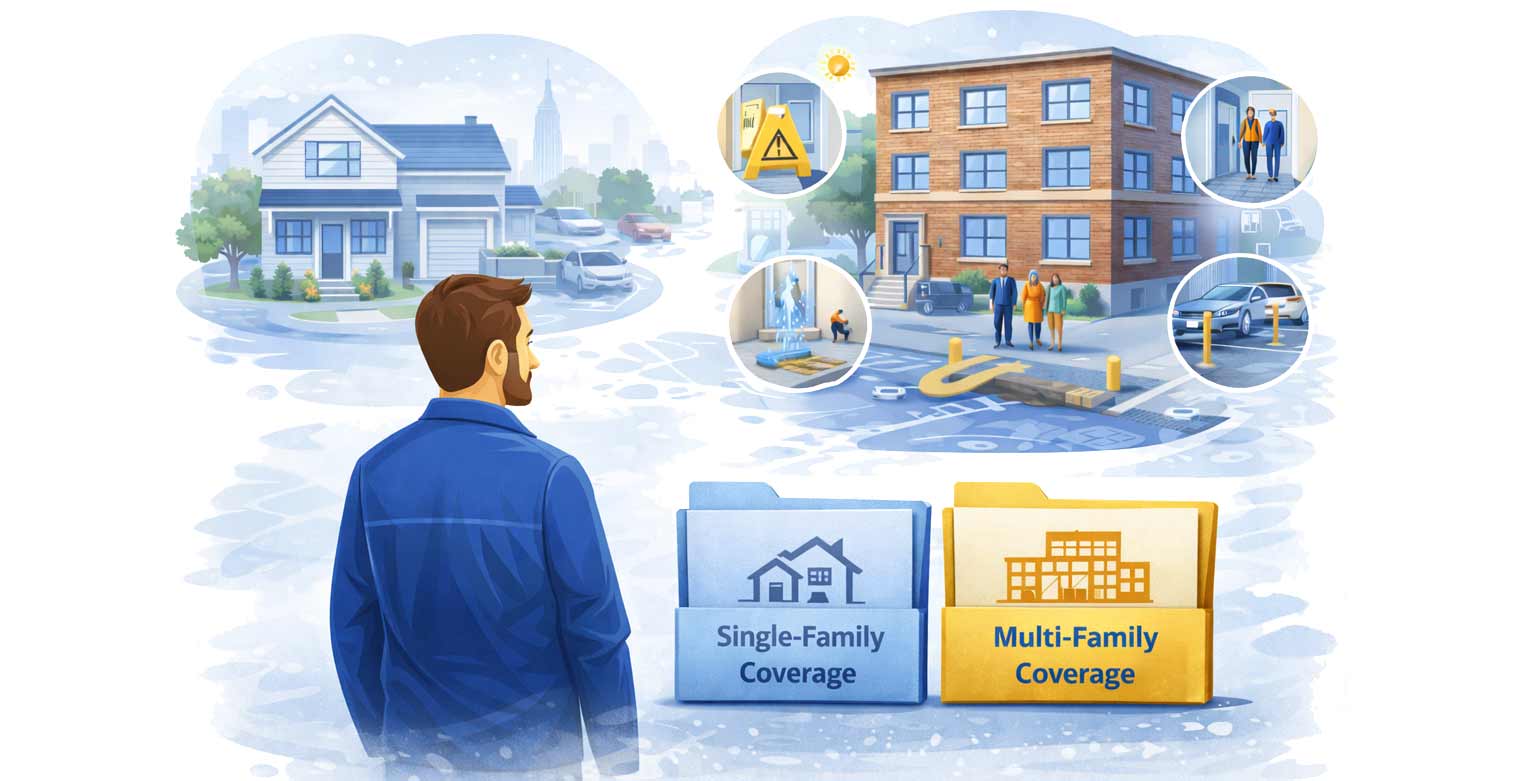
Owning a rental in New York is one thing. Owning a 12-unit building with shared hallways, stairwells, and parking lots is something else entirely. The more people you house under one roof, the more moving parts there are—and the more ways things can go wrong.
That’s why landlord insurance for multi-family properties in New York looks and behaves differently than coverage for a single-family rental. Both need to protect the building and your liability, but the scale of risk, the coverage structure, and even the cost drivers can diverge pretty quickly. At Weed Ross, we work with landlords on both sides of that spectrum—from first-time single-family investors to owners of larger multi-unit portfolios—and we see where the confusion happens.
In this article, we’ll cover:
- How risks differ between single-family and multi-family rentals
- Coverage basics that both types of properties need
- The extra coverage considerations for multi-family buildings
- Special cases like owner-occupied and mixed-use properties
- How a local independent agency like Weed Ross helps you choose wisely
Risks of Single-Family vs. Multi-Family
On paper, a three-bedroom rental house and a 10-unit apartment building are both “investment properties.” In reality, the exposures are very different.
- Single-family rentals typically have:
- Fewer occupants and visitors overall
- No interior common areas or elevators
- Simpler mechanical systems
- Lower total target value for lawsuits
Multi-family properties, especially 5+ unit buildings, bring higher foot traffic, shared spaces, more complex systems, and often higher property values—all of which increase both the frequency and severity of potential claims.
Coverage Basics Both Types of Properties Need
No matter what you own, a few fundamentals apply to both single-family and multi-family rentals in New York.
Dwelling / Property Coverage
You need coverage that insures the structure against covered perils such as fire, wind, hail, and vandalism. For single-family rentals, this might be a landlord or dwelling policy. For multi-family, especially in cities, it will usually be a commercial property policy. Either way, the limit should reflect realistic rebuilding costs—not just what you paid for the property.
Liability Protection
If a tenant or guest is injured on the property and alleges negligence—broken handrail, icy walkway, poor lighting—you want the claim going to your insurer, not your personal bank account. Liability coverage is built into landlord and multi-family building policies and can be supplemented with an umbrella policy for larger portfolios.
Loss of Rental Income / Business Income
If a covered loss (like a fire, significant water damage, or storm damage) makes the property uninhabitable, loss-of-rents or business income coverage replaces the rental income you’d otherwise lose during repairs. This can be the difference between staying solvent and being forced to sell.
Optional Flood and Sewer Backup
Standard landlord and building policies generally exclude flood damage and may limit sewer backup coverage. Given New York’s weather patterns and aging infrastructure, both are worth discussing—especially for basements and lower-level units.
What’s Different for Multi-Family Properties?
Once you move into true multi-family territory, especially 3+ or 5+ units, additional issues come into play.
Higher Liability Limits and Broader Risk
With more people in and out of the property, the odds of a slip-and-fall, stairwell accident, or common-area injury go up. Insurers often recommend or require higher liability limits for multi-family buildings than for single-family rentals.
Common Areas and Shared Systems
Hallways, stairwells, lobbies, parking lots, laundry rooms, playgrounds—multi-family properties have more shared spaces, each with its own exposure. Your policy needs to clearly cover these areas and any fixtures, furnishings, or equipment inside them.
Business-Style Coverages
Multi-family building policies often include or strongly recommend:
- Business income (loss of rents) coverage
- Ordinance or law coverage to handle building code upgrades after a loss
- Water/sewer backup coverage
- Workers’ comp if you have on-site maintenance, management, or security staff
Because these properties are treated more like businesses, coverage tends to be structured with that in mind.
Stricter Underwriting and Higher Costs
From an insurer’s standpoint, a 24-unit building is simply a different animal than a stand-alone rental home. Premiums are higher, and underwriting questions get more detailed—age of wiring and plumbing, presence of sprinklers, security measures, and tenant profile all matter.
How Weed Ross Helps New York Landlords Right-Size Their Coverage
As a local independent agency, Weed Ross doesn’t push a single cookie-cutter product. We work with a wide range of carriers and already write coverage for single-family landlords, small multi-family owners, and large habitational portfolios across Western and Upstate New York.
Here’s what we do for landlords:
- Review your current policies to see whether you’re insured as a homeowner, landlord, or commercial building owner—and whether that actually matches reality.
- Help you understand where multi-family risks require stronger or different coverage than a single-family rental.
- Structure coverage—property, liability, loss of rents, flood, umbrella—in a way that protects your equity without overpaying for bells and whistles you don’t need.
- Consolidate multiple properties where it makes sense, or keep them separated when lenders or ownership structures require it.
If you own rentals in New York—whether it’s your first single-family or your tenth multi-unit building—your insurance should reflect the real risks you’re taking, not just the bare minimum it takes to close a loan. Reach out to Weed Ross, and we’ll help you compare options and build landlord coverage that actually fits your portfolio.